Pauline and Pecola Breedlove
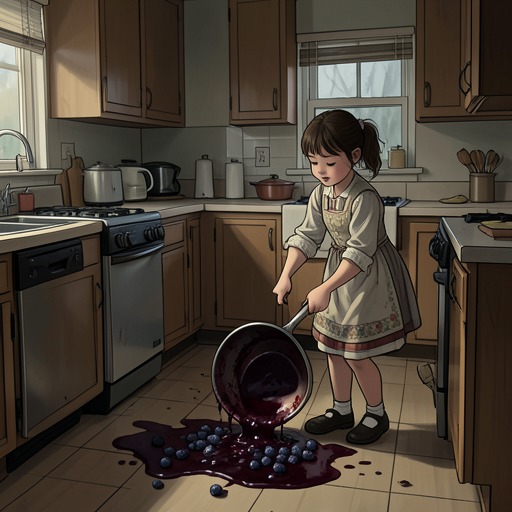
The Bluest EyePauline and Pecola Breedlove are mother and daughter, yet their relationship is shaped by a painful imbalance: Pauline maintains order and tenderness for the white family she serves while withholding comparable care from Pecola. In a pivotal kitchen scene, a dropped pan of blueberries brings that division into the open. Pauline knocks Pecola down over the spill, then comforts her employer’s crying child, making the contrast between the two girls’ treatment impossible to miss.
Identity and Background
Pauline is Pecola’s mother and a domestic worker in the Fisher household. Her work gives her access to a home whose order and beauty she values, but that private world does not carry over into her own storefront home or her relationship with her children. The narration observes that Pauline keeps this order and beauty for herself; at home, she directs her children toward respectability instead. This division is not merely a difference in household standards: it marks how differently she invests care in the world of her employment and in the family that depends on her.
The contrast is reinforced by Pauline’s account of motherhood. Remembering the birth of her second child, a girl, she recalls saying that she would love the baby regardless of her appearance. That recollection sits uneasily beside Pecola’s experience of being struck and treated as an unwanted source of disorder. The relationship therefore holds together a remembered or intended promise of maternal love and the failures of care that define Pecola’s childhood.
The Kitchen Incident
The blueberry-pie scene makes Pauline and Pecola’s relationship visible through a sequence of ordinary household actions and a sudden reversal. Pecola is at work in the kitchen when the pan tilts from her hands and falls, scattering the berries. Pauline enters carrying a tightly packed laundry bag. She knocks Pecola to the floor, and her attention centers on the mess and her floor. The spilled pie becomes the immediate cause of the confrontation, but the scene’s force comes from what happens next, not from the accident alone.
Pauline turns from Pecola to the little girl in pink, who has begun to cry. She hushes and comforts her, worries over the child’s dress, and reassures her that she will make another pie. The same woman who has just driven Pecola away now offers the employer’s child the soothing attention her own daughter does not receive. As Pecola puts the laundry bag in the wagon, she and the other girls hear Pauline continuing to comfort the child and promise another pie. The care is practical as well as affectionate: Pauline attends to the dress, the tears, and the prospect of replacing what has been lost.
The scene’s structure sharpens the comparison. Pecola’s mistake and pain are met with punishment; the white child’s distress is met with reassurance. Pauline’s language and gestures change with the person she addresses, turning a single kitchen into a display of unequal maternal attention. The difference is not inferred from a general statement about Pauline’s character: it unfolds in immediate succession, in front of Pecola, as she is made to leave while the other child is comforted.
Care, Work, and Home
Pauline’s employment is central to the relationship’s imbalance. She can preserve an orderly, beautiful domestic world in the Fisher household and is described as an ideal servant, but the order she creates there is kept apart from her own children. At home, the things she can afford do not last and seem to her to lack beauty or style; she eventually stops trying to maintain her own house in the same way. The novel places that deprivation beside Pauline’s work without suggesting that the two settings offer her equal power or resources.
Yet the difference in her treatment of the children is more than a contrast between a well-kept workplace and a poor home. In the pie scene, Pauline has enough composure to comfort the Fisher child and promise a replacement pie, even as she responds to Pecola’s accident with force and expulsion. Her skilled labor and tenderness are real, but their distribution is selective. Pecola sees the care Pauline can give, because it is performed in the same room and at the same moment that Pauline refuses it to her.
The narration also links Pauline’s priorities to social expectations of respectability. She bends her children toward respectability while keeping the beauty and order of her working life separate from them. For Pecola, this arrangement offers neither the material security Pauline seeks nor the affectionate protection that might make the home a refuge. The daughter is left at the edge of a domestic ideal that her mother helps sustain for someone else.
The Relationship’s Consequences
Pecola’s position in the relationship is marked by both direct violence and emotional exclusion. The kitchen incident shows her treated as the cause of disorder even when the spill is accidental: she is struck, ordered out, and left to carry the laundry bag away. In the same scene, she witnesses Pauline’s gentleness toward the child whose pie has been spoiled. The contrast gives the rejection a concrete form, joining a household task to a painful lesson about whose distress receives sympathy.
The novel’s wider portrait of Pauline makes the incident part of a sustained pattern rather than an isolated outburst. Pauline recalls struggling with her children and says she could not seem to stop herself from yelling at and beating them. Her memory of promising to love her second daughter regardless of appearance exposes a gap between intention and practice; it does not undo the harm Pecola experiences. The relationship is thus presented through a tension between a mother’s recollection of what she meant to feel and the repeated consequences of how she acts.
Pauline’s care for the employer’s child does not repair her bond with Pecola. Instead, it makes the failure more legible: Pecola is close enough to see that Pauline is capable of soothing, attentiveness, and reassurance, but those gestures are directed elsewhere. The mother-daughter relationship becomes one of the novel’s clearest demonstrations of love and care becoming unequal in practice, under the pressures of poverty, domestic labor, and a social order that assigns different value to different children.
Narrative Significance
Pauline and Pecola Breedlove’s relationship brings the novel’s concerns with beauty, labor, and belonging into the intimate space of the family. Pauline’s attachment to order and beauty finds a protected outlet in her work, while her own children are denied entry to that private world. The kitchen scene condenses the larger division into a single, consequential contrast: Pecola is punished for the spoiled pie, while the white child is comforted and promised another.
The scene also shows how social inequality operates through ordinary acts rather than abstract declarations. A laundry bag, a spilled pan, a child’s tears, and the promise of another pie organize the encounter; their sequence reveals the unequal distribution of Pauline’s attention. Pecola’s exclusion is not only a matter of what her mother says about her. It is enacted when Pauline sends her away and turns toward another child with tenderness, leaving Pecola to witness the care she herself needs.